The Hero of Haarlem plugs the dike
Hans Brinker, or The Silver SkatesThe Hero of Haarlem plugs the dike is an embedded schoolbook legend about a child who discovers a leak in a dike and holds back the water through a long, cold night. The story makes the danger of a small breach immediate, then enlarges one boy’s stubborn vigil into an image of the collective vigilance Holland depends upon to remain habitable.
Setting and Stakes
The lesson first explains the system the boy’s act protects. A sluicer, the boy’s father, opens and closes the large oaken gates placed at intervals across canal entrances, regulating the water that flows through them. He must adjust the gates to the amount required and close them carefully at night: a careless oversupply could overflow a canal and inundate the surrounding country. Since much of Holland lies below sea level, sluices and strong dikes stand between ordinary life and ruin. The lesson insists that even children understand how much continuous attention that arrangement demands.
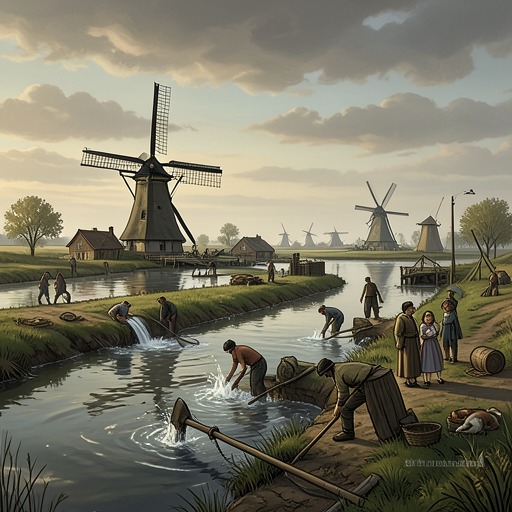
The wider account makes this danger part of the country’s material landscape. Dikes are costly barriers against the sea, and a failure can have disastrous consequences. Rivers and inland waters also threaten the lowlands, especially during spring thaws, when ice can obstruct rivers as their waters rise. Engineers and workmen watch threatened places day and night; when danger signals are given, inhabitants rush to help. Straw mats reinforced with clay and stone can be pressed against embankments to resist the tide. Against this background, the boy’s finger is at once a child’s improvised answer to an emergency and a miniature of a national labor of maintenance.
The Leak and the Boy’s Decision
The boy is walking home with flowers when he notices that the sun has set. Far from home, in a lonely ravine, he hears water trickling and finds a small hole in the dike. He understands that the danger lies not only in the stream already escaping: left alone, the opening could grow, allowing a disastrous inundation. The narrative makes recognition and action almost simultaneous. He throws away his flowers, climbs the dike, and thrusts his finger into the hole, stopping the flow.
That immediate success becomes a test of endurance. Darkness gathers, cold vapors fill the air, and the boy begins to tremble. He calls and screams for help, but nobody comes. His mother has locked the doors, intending to scold him the next day for spending the night with blind Jansen without permission. Unable to whistle because his teeth are chattering, the boy calls on God and resolves to stay until morning. The resolve does not make the danger or pain disappear; it commits him to endure them rather than withdraw the small barrier on which the town’s safety now depends.
The Night Watch and Discovery
The lesson lingers over the solitary hours instead of skipping directly to rescue. In moonlight, the child sits halfway up the dike, his head bent but his eyes open. One hand weakly rubs the arm held against the embankment, while his pale face turns at real or imagined sounds. He thinks of the warm bed and his family, then faces the cold night again. The story describes numbness, pain, and fear, and leaves open whether he will live through the vigil. The threatened value is therefore both the town’s safety and the boy’s own life: preserving one depends, for the moment, on putting the other at risk.
At daybreak, a clergyman returning from the bedside of a sick parishioner hears groans as he walks along the dike. Looking down, he sees a child apparently writhing in pain and asks what he is doing there. The boy explains that he is keeping the water from running out and asks the clergyman to summon help. The lesson says that help comes quickly, but the schoolroom reading breaks off before it relates what followed. That cutoff keeps the moment of discovery—an isolated child found at the breach—at the center of the scene rather than supplying an unsupported account of the aftermath.
Story Within the Story
The legend is presented through two acts of transmission. In an English schoolroom, Robby begins reading the lesson aloud; after the teacher calls on the next pupil, Jenny continues with the boy’s ordeal. She becomes visibly moved, and the teacher pauses her when she cannot read distinctly. At the same time, across the sea, Ben is discussing the story with Lambert van Mounen. Ben has encountered accounts of the incident before, but did not know it was true. Lambert says he learned it from his mother and presents it as familiar knowledge among Dutch children.
Lambert’s explanation turns the tale from a single rescue story into a national emblem. The little boy, he says, represents the spirit of the country: whenever a leak appears in its politics, honor, or public safety, a million fingers are ready to stop it at any cost. Ben dismisses this as grand talk, but Lambert quietly insists that it is true. The lesson’s structure supports that claim through repetition rather than argument alone: its account of constant dike-watchfulness makes the boy’s vigilance an extreme instance of a shared duty.
The episode also resonates with the book’s account of actual dike labor. Raff Brinker, the father of Hans Brinker and Gretel Brinker, worked on the dikes for years. During a threatened inundation, he fell from scaffolding near the Veermyk Sluice in a storm and was left without his mind or memory. The legend celebrates courage at a breach; Raff’s history makes visible the danger borne by the workers who maintain the defenses. Together, the stories present water control not as a settled triumph over nature, but as costly work requiring continual attention, communal response, and individual risk.